
PolyMap: A 64-Channel Polyphonic Guitar Pickup System
What if the pickup position wasn’t fixed by where hardware happens to sit in a guitar, but instead became a software parameter?
PolyMap is a 64-channel polyphonic guitar pickup system that captures each string at eight different positions simultaneously. Instead of committing to a bridge or neck pickup during construction, the instrument records spatial information along the strings and allows pickup position, blending, and routing to be defined later inside a DAW.
This opens up applications that are simply not possible with conventional pickups. Pickup position can be adjusted after recording. Strings can be spread across the stereo field. Lower strings can be routed to a bass amp, while upper strings go to a guitar amp. Multiple pickup positions per string can be blended and delayed to create physically grounded spatial effects. The guitar no longer has a single analog output but becomes a spatially mapped instrument.
Under the hood, achieving this required building a complete multichannel signal chain: 64 active pickups, analog buffering and filtering, simultaneous analog-to-digital conversion, FPGA-based data encoding, MADI transmission, and a dedicated control plugin.
This post walks through the system architecture, design tradeoffs, measured performance, and what it enables musically.

System Overview
64 active pickups are arranged as an 8×8 grid across the strings. Their analog outputs are buffered and bandwidth-limited before being digitized by eight 8-channel ADCs. An FPGA takes the digital signals and encodes them into a MADI stream. This is then sent out of the guitar over a coax cable. A USB MADI interface converts that stream into a standard multichannel audio device on the computer. Inside the DAW, a custom plugin provides control and mixing functionality.
The guitar is powered using the same coax cable by injecting power into it. This means only one cable is required, and there is no need to worry about running out of battery.
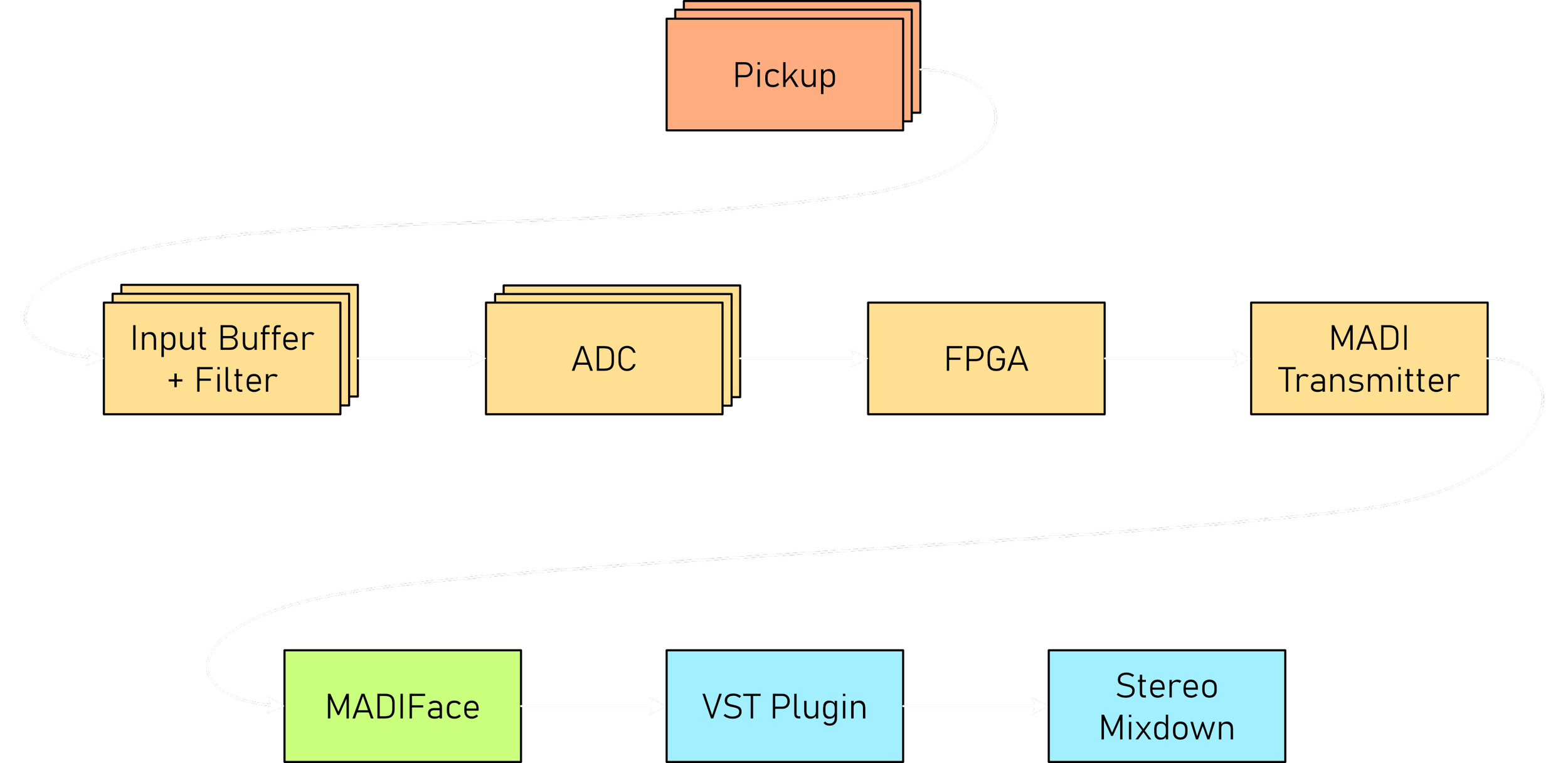
Signal Flow Diagram of the PolyMap Pickup System
The Pickup Array
Fitting 64 pickups into the limited space between the bridge and fretboard required very small, highly directional units. The Cycfi Nu Capsules are chosen as they are small and specifically designed for poliphonic pickup applications. They are active full-spectrum pickups. This means, unlike traditional passive high-impedance pickups, which exhibit low-pass behavior and characteristic resonance in the 2–6 kHz range, these pickups have a largely flat response well beyond 20 kHz.
The pickups are soldered to a PCB, which connects power and routes the signals to connectors at the edge. This PCB is also used to mount the PolyMap system to the guitar body using 6 M3 screws. Underneath the pickup array sits the control board, which processes the analog signals coming from the pickups.
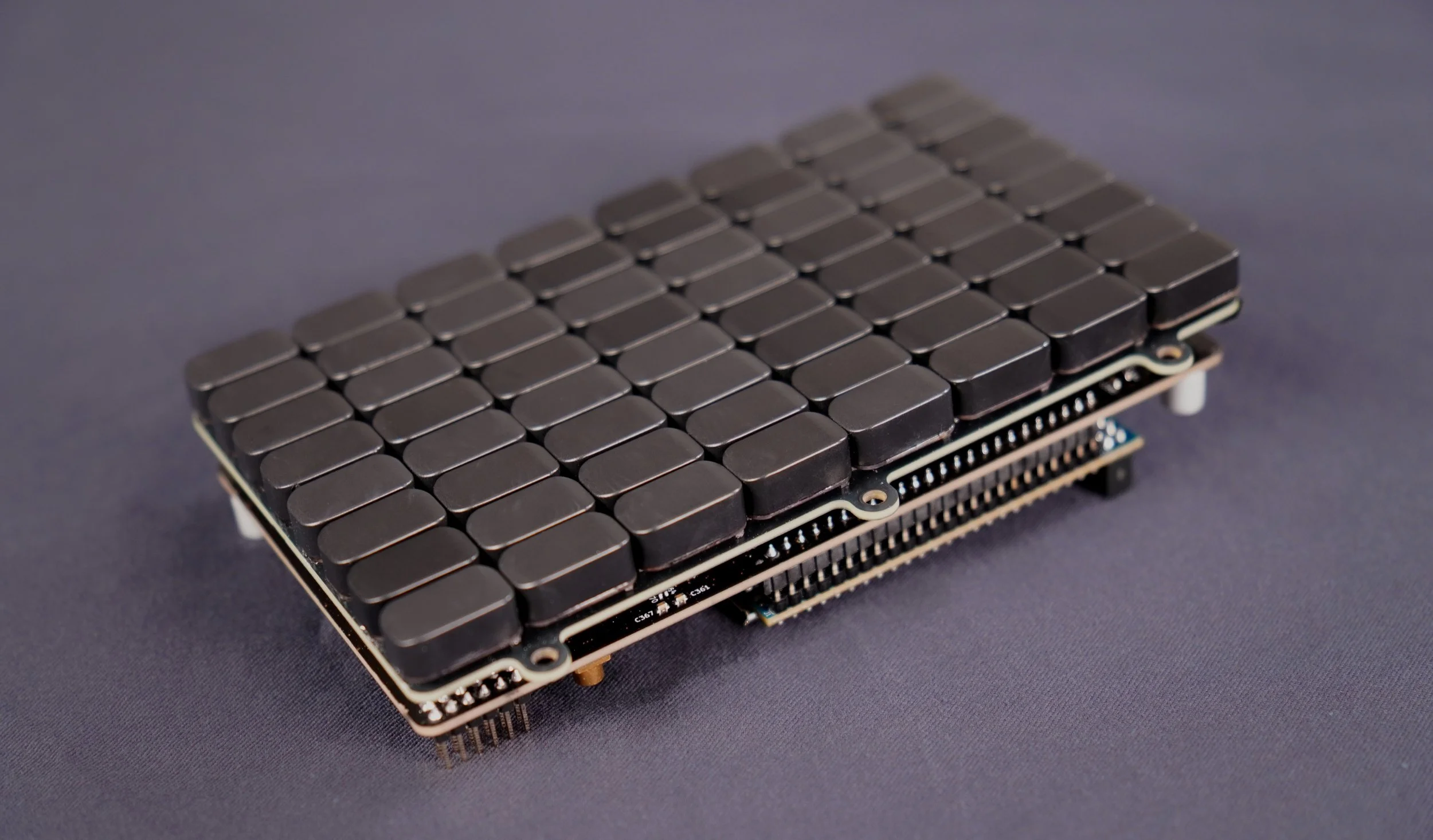
Assembled PolyMap Pickup System with the Pickup Array on top and the Control Board underneath
Analog Frontend and Conversion
For optimal performance, each channel requires buffering, impedance matching, and bandwidth limiting before digitization. A fully differential frontend would provide optimal performance, but replicating that 64 times significantly increases component count and board complexity. Prototype measurements showed that a single-ended 3rd-order bandpass topology achieved very similar performance in this application. Given the scale of replication, the simpler solution was chosen.
Digitization is performed by 8 audio ADCs with 8 channels each from Cirrus Logic. Every ADC channel has a dedicated converter, and all channels per chip are sampled simultaneously. Maintaining precise time alignment across pickup positions is essential, since the plugin may later blend signals from multiple locations along a string.
The ADCs require a bit clock for the output data stream, as well as a synchronization clock for sampling. The 48 kHz sample clock and 12.3 MHz bit clock are generated by the FPGA.
Digital Transport: MADI and the Path to USB
The most natural long-term solution for connecting to the PC is native USB. A class-compliant 64-channel USB audio interface built directly into the guitar would make the instrument plug-and-play with any computer and eliminate the need for external format converters.
However, implementing a robust, low-latency, cross-platform USB audio interface inside the instrument significantly increases development complexity. Therefore, for the first implementation, simplicity was prioritized by using a proven industry standard.
The PolyMap pickup system uses AES10, better known as MADI (Multi-channel Audio Digital Interface). MADI is a mature professional standard capable of transporting up to 64 24-bit audio channels at 48 kHz with a fixed 125 Mbit/s line rate. The FPGA formats the pickup data into a compliant MADI stream, which is then converted to USB externally using a commercial interface (RME MADIFace USB).
This approach reduces complexity by delegating USB protocol handling to proven external hardware. The internal architecture does not depend fundamentally on MADI. The FPGA controls the ADC and aggregates all audio channels into a digital stream. Replacing the MADI output stage with a native USB implementation is a planned next step.
FPGA Data Processing
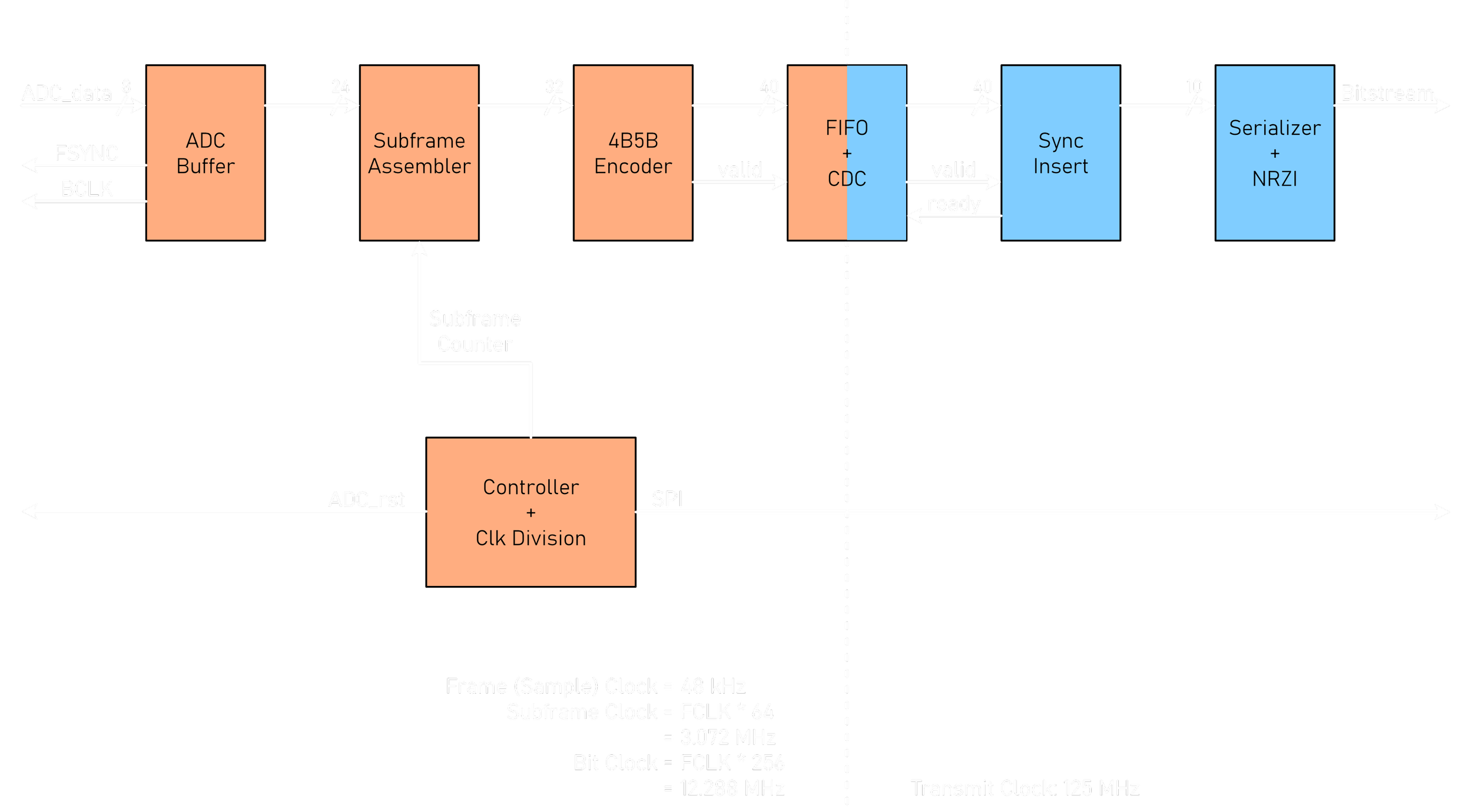
Block Diagram of the RTL Logic Running on the FPGA
The FPGA chosen is a Xillinx Artix 7 on a Digilent CMOD A7-35T development board. This makes integration much easier as non-volatile memory, JTAG programmer, clocking sources, and more are already integrated.
Inside the FPGA, the data streams from the ADCs are reconstructed into parallel audio samples. These are assembled into MADI subframes, containing the 24-bit raw audio data as well as some status and parity bits. They are then encoded using 4B5B coding to eliminate any long sequences of ones or zeros. Synchronization symbols are inserted after every MADI frame to allow the receiver to maintain alignment for proper decoding. The final stage serializes the data and applies NRZI encoding.
The resulting bitstream has a bitrate of 125 Mbit. To drive the output, a MADI cable driver from Texas Instruments is used. For correct operation, the cable driver needs to be programmed over SPI during boot up. This is handled by the FPGA as well.
Power Supply
The system’s total power consumption is roughly 4.6 W, making battery operation impractical. Using separate power and data cables would be the easiest, but not very elegant or convenient.
Instead, 12 V DC is injected onto the same 75 Ω coaxial cable that carries the MADI data. Because the audio signal occupies high frequencies and the power is DC, filtering cleanly separates the two. This is known as power over coax and the same fundamental idea as phantom power with microphones.
Inside the guitar, switching converters generate 5 V and 3.3 V rails for digital and analog circuitry, while linear regulation and additional filtering provide a low-noise 9 V supply for the pickups. Early prototypes revealed that magnetic fields from switching inductors could couple into nearby pickups. A second power board revision reduced this significantly by increasing switching frequency and reducing inductor size.
The Control Plugin
The MADI interface exposes 64 audio channels to the computer. While it would be possible to mix them manually in a DAW, this would significantly limit the usefulness of the system. For this reason, we developed a custom plugin that provides a convenient interface to choose which pickups are active and apply various effects.
Most DAWs do not support 64-channel tracks, which is why the current implementation only works with Reaper, which allows arbitrary channel counts.
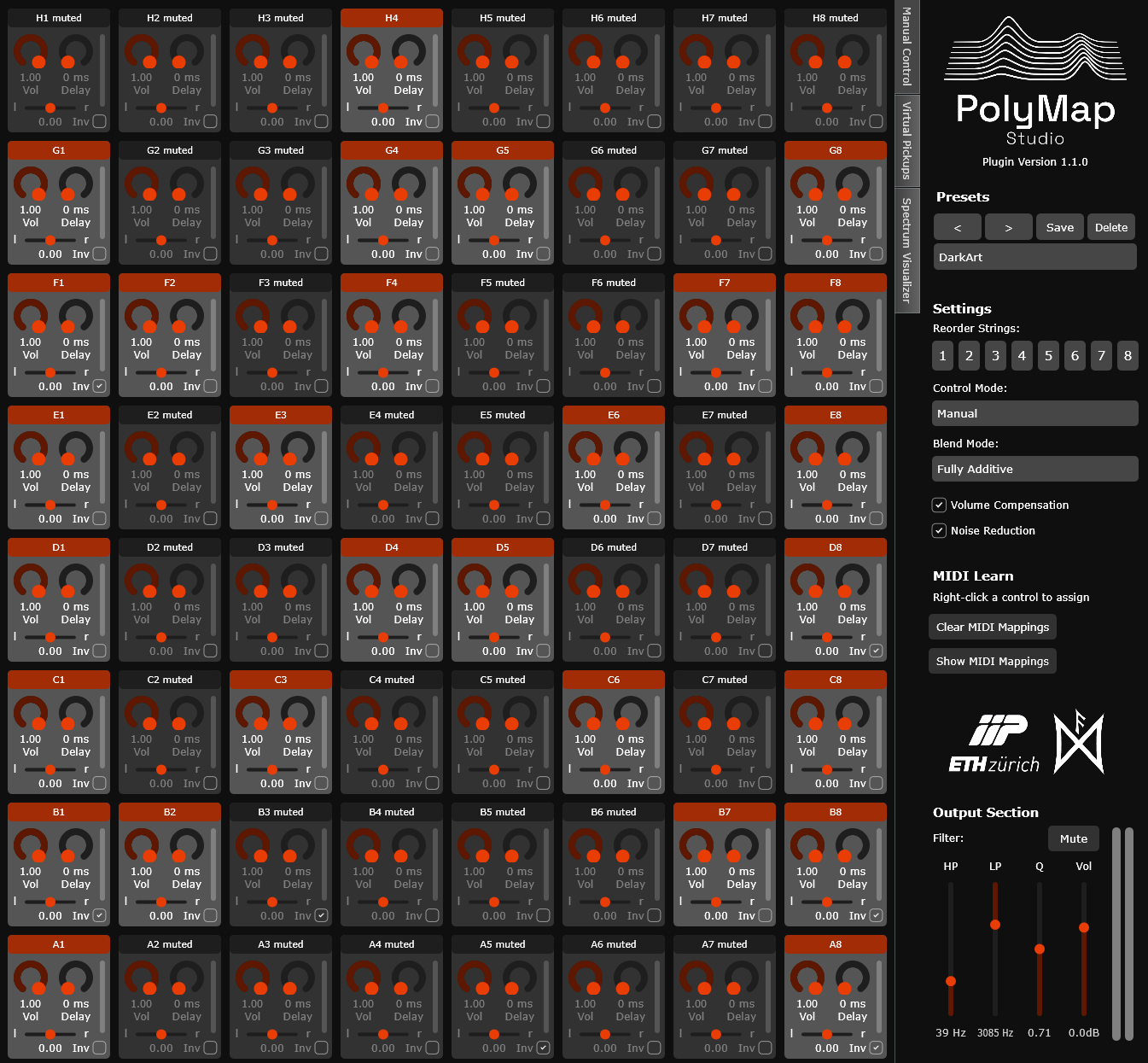
Manual Control Tab of the PolyMap Studio VST Plugin
The plugin offers two primary control paradigms. In Manual Mode, each pickup can be enabled, level-adjusted, inverted, panned, and optionally delayed. This allows detailed spatial control and experimentation.
In Virtual Pickup Mode, a continuous pickup position is selected per string. If the chosen position lies between two physical pickups, the plugin blends them proportionally. Strings can be linked for global movement or controlled independently. This makes the system feel intuitive while retaining flexibility. The string pickups can also be panned for stereo effects.
Because the Nu Capsules output a fair amount of high-frequency noise (hiss), in addition to a low-pass filter on the output, active noise reduction has been implemented. It is active whenever the input level is below a threshold. It works with a moving average filter and has a smooth transition where it blends with the raw signal (based on input level) before fully activating.
An adjustable output filter recreates traditional pickup frequency responses when desired. It is implemented as a high-pass filter plus a resonant low-pass filter. Since the pickups themselves are wideband, tone shaping can be applied after recording rather than being baked into the hardware.
Additional features include preset management, allowing you to store preconfigured parameter sets, MIDI mapping for all parameters, and a real-time multichannel spectrum analyzer.
Latency and Performance
One of the most important things for a digital guitar pickup system is latency. Because this has been a focus from the beginning, the final product has very little latency, on par with or even better than commercial audio interfaces.
End-to-end latency was measured from the pickup to the headphone output of the computer. The PolyMap hardware itself contributes very little delay, only around 5 samples. The MADI interface adds another 27 samples, with the dominant factors being DAW buffer size and operating system audio buffering.
With a buffer size of 32 samples, the total end-to-end latency is 259 samples or 5.4 ms. As a comparison, using a Presonus Audiobox USB 96 with the same buffer size results in an end-to-end latency of 6.1 ms. These measurements were done on an M4 Mac mini.
CPU usage depends on the number of active pickups and whether noise reduction is enabled. Even with multiple pickups active per string, system load remains modest on modern hardware. While both macOS and Windows are supported, the performance on macOS is significantly better.

End-to-end Latency of the PolyMap Pickup System Compared to an Audio Interface

Breakdown of the Latency Contributions
What This Enables
A clever technical music system is only as good as the sonic expressions it enables. This chapter gives an idea of what is possible, but it is by no means an exhaustive list. In the demo video below, you can hear the various effects. The guitar signal goes from the guitar to the MADIFace USB, then into Reaper. The PolyMap Studio plugin takes the 64 inputs and mixes them into a stereo signal. This is then sent to the Neural DSP Archetype Nolly amplifier simulation plugin.
Big thanks to Marc Schaffo of Artifiction for playing the demos. Check them out here: https://www.artifictionband.com
Spacial Audio
By far the most immediately impressive effect that is simply not possible with a regular guitar is to spread the different strings of the guitar in space. By simply panning every string slightly differently in the stereo field, the result is a sound that feels big and immersive. This is especially pronounced when playing things that move across the strings, like arpeggios. It can also be used more subtly, spreading the sound only slightly, or by spreading additional pickups of the same string in the stereo field. This retains a more traditional, focused sound but adds additional depth that would usually require multi-tracking.
Delay Effects
By enabling multiple pickups per string and selectively adding delay to some of them, an effect similar to reverb or a fast delay pedal can be achieved. The difference is that the timbre also changes with the delayed parts, without the need for any effects. It can be hard to distinguish this effect from a feature-rich delay pedal, but it is nonetheless interesting to experiment with, especially combined with stereo effects.
Split Processing
With separate pickups per string, there is no reason why all of the strings need to be sent to the same effects and amplifier. By using an additional track in the DAW, a second instance of the plugin can be used, routing the resulting mix to an entirely distinct signal chain. The possibilities with this are endless, but one example would be to send the lower strings to a bass guitar amplifier while sending the upper strings to a guitar amplifier. Adding delay or reverb only to the higher strings but not the lower ones, or using clean versus distorted sounds, would be another idea.
Fractional Blending
Instead of enabling multiple pickups per string at full volume, adding a second one with reduced volume allows for much finer control of the resulting sound. Another interesting take on this is to invert one of the pickups, adding them 180 degrees out of phase. This will cancel a lot of the fundamental frequency, accentuating the higher harmonics and attack that are significantly different between the two positions. Adding both at full volume creates a stark effect that can be a bit much. While it is possible to achieve this with some wiring techniques on a regular guitar with a humbucker pickup, what is not possible is to add a second pickup at only a reduced volume. This means you can blend seamlessly between the normal and the phase-canceled sound.
Current Limitations
The system currently requires an external MADI interface and is limited to DAWs that support high channel counts. However, the biggest limitation to a commercial realization is the component cost. 64 individual pickups, 8 high-end audio ADCs, an FPGA development board, and many more components add up very quickly. A possible cost-cutting measure would be reducing the number of pickups per string. This would barely impact the possible applications while making the system much more approachable.
Conclusion
PolyMap turns the electric guitar from a single analog sensor into a 64-channel spatial measurement system. By separating physical capture from tonal decision-making, it moves pickup position, spatial imaging, and aspects of timbre into the digital domain.
The current implementation validates the core idea: spatially sampling the strings produces musically useful flexibility without prohibitive latency or impeding the playability.
If you wish to be kept up to date about the development of the PolyMap Pickup System and a possible commercial launch, you can sign up with your email below.
PolyMap is now Open-Source
The source material for the hardware, FPGA logic, as well as software plugin is available on GitHub.
If you would like to play around with a recording of the PolyMap guitar, the raw audio file as well as the VST PolyMap Studio plugin are also available.